

Research
Our modern life cannot exist without organic compounds. They are widely utilized in our daily life ranging from medicines, fibers, plastics, and optoelectronic materials. Because organic compounds can display various functions depending on their molecular structures, it is highly important to develop synthetic methods to produce organic compounds with precisely controlled structures at a molecular level.
In the Shintani research group, we particularly aim to
-
“Discover new reactivity of organic molecules by the power of catalysts”
and thereby actively carry out research programs in the following aspects:
“Development of new selective organic reactions”“Creation of new organic molecules and their functions”
1. New Molecular Transformations by Activation of Remote Unactivated Bonds via Catalyst Metal Migration
Activation of stable and unreactive bonds of organic molecules toward installation of new functional groups or construction of new molecular skeletons represents a powerful and important way to provide efficient synthetic methods in organic chemistry. In this regard, our group explores transition-metal-catalyzed processes involving the migration of catalyst metals within organic frameworks to activate remote unreactive bonds for the development of unconventional and highly selective organic transformations.
In recent years, we have been focusing on the synthesis and use of organic compounds containing silicon, a congener of carbon possessing both similarity and difference, and have devised various synthetic methods of useful organosilanes that are difficult to prepare by existing methods through the development of a new way of activating carbon–hydrogen and carbon–silicon bonds with nickel- or palladium-based catalysts [1]. For example, we successfully developed a nickel-catalyzed synthesis of silaindanes through a novel sequential process involving an exchange between carbon–nickel and remote carbon–hydrogen bonds followed by an exchange between carbon–nickel and remote carbon–silicon bonds [2]. In addition, we also achieved a regioselective synthesis of benzylsilanols from 2-methylsilylaryl triflates, typically used as aryne precursors, by a mechanistically distinct approach involving an exchange of carbon–palladium and remote carbon–hydrogen bonds followed by the cleavage of a carbon–silicon bond without generation of aryne intermediates [3].


Recent publication:
- Review article: Shintani, R. Chem. Lett. 2024, 53, upae132.
- Lee, D.; Fujii, I.; Shintani, R. ACS Catal. 2025, 15, 907.
- Shintani, R.; Tachibana, K. Angew. Chem., Int. Ed. 2026, 65, e2809429.
2. New Stereoselective Organic Reactions Using Organosilicon Nucleophiles
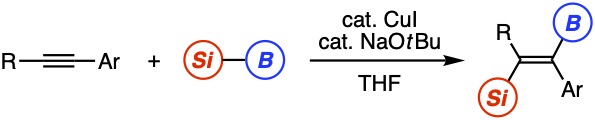
Silicon-containing organic compounds, organosilanes, do not exist in nature, but they constitute an attractive class of compounds that can be used as biologically active substances or functional organic materials, in addition to intermediates in organic synthesis. However, accessible molecular structures are currently limited, and it is therefore necessary to develop new molecular transformations for further expansion of functional organosilanes. Our group is particularly focusing on the stereoselective synthesis of complex organosilicon compounds by installing silicon as a nucleophile to unsaturated organic molecules in the presence of appropriate catalysts.
For example, we recently achieved a regio- and stereoselective synthesis of silicon- and boron-containing tetrasubstituted alkenes by a copper-catalyzed anti-selective addition of silylboronates to unsymmetric internal alkynes [1,2]. In addition, we also developed a regio- and stereoselective synthesis of silicon- and boron-containing highly substituted silacyclopentanes by an alkoxide-catalyzed cyclosilylborylation of dialkenylsilanes with silylboronates [3].

Recent publication:
- Moniwa, H.; Shintani, R. Chem. Eur. J. 2021, 27, 7512.
- Moniwa, H.; Yamanaka, M.; Shintani, R. J. Am. Chem. Soc. 2023, 145, 23470.
- Ueji, K.; Shintani, R. J. Am. Chem. Soc. 2026, 62, in press.
3. New Transformations Based on the Precise Design of Radicals
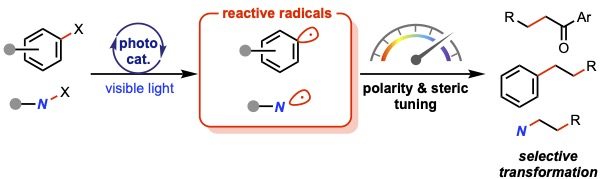
Radicals are highly reactive intermediates that have attracted considerable attention in recent years as powerful tools for diverse organic transformations. However, because of their high reactivity, precise control of their selectivity is often difficult. In this regard, our group aims to develop new organic transformations by precisely tuning the electronic and steric properties of radical species.
Visible-light-driven photoredox catalysis represents a particularly useful platform for this purpose, because it enables the generation of radicals under mild conditions. By taking advantage of this feature, our group is focusing on the control of the properties of various radical intermediates, including aryl radicals and nitrogen-centered radicals, for the development of selective molecular transformations that are difficult to achieve by conventional methods. For example, we recently realized selective hydrogen atom abstraction from otherwise inert carbon–hydrogen bonds followed by carbon–carbon bond formation through the proper design of aryl radicals generated by photoredox catalysis, and experimentally and computationally clarified that the electronic and steric factors of the radicals play important roles in determining their reactivity [1].
Recent publication:
- Fujii, I.; Mori, T.; Shintani, R. Tetrahedron 2026, 189, 134971.
4. New Chain-Growth Polymerization Reactions toward New Polymer Synthesis
Catalytic organic reactions are indispensable in modern synthetic organic chemistry, and this is also true for the polymer synthesis. Various interesting reactivity has been found for small molecule synthesis depending on the choice of catalysts. If this knowledge can be effectively applied to polymer synthesis, efficient synthesis of new functional polymers that are currently inaccessible may become possible. In this regard, our group aims to explore creation of new polymers through the development of new types of catalytic polymerization reactions.
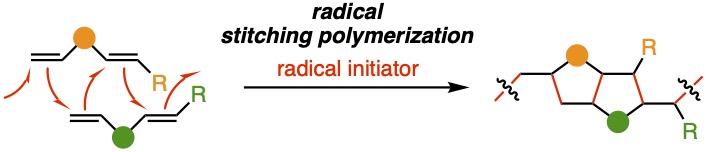
For instance, catalytic reactions involving insertion of a carbon–carbon unsaturated bond into an organorhodium species are widely utilized as one of the powerful synthetic methods. Based on this insertion process, we developed a new mode of polymerization named “stitching polymerization” to achieve efficient synthesis of new π-conjugated polymers that are difficult to synthesize by conventional polymerization methods and evaluated the physical properties of the obtained polymers as well [1,2]. We also expanded the stitching polymerization to anionic polymerization and radical polymerization for the convenient and selective synthesis of new polymers possessing saturated fused polycyclic repeating units with high thermal stability and transparency [3,4].

Recent publication:
- Ikeda, S.; Hanamura, Y.; Tada, H.; Shintani, R. J. Am. Chem. Soc. 2021, 143, 19559.
- Togawa, S.; Shintani, R. J. Am. Chem. Soc. 2022, 144, 18545.
- Ikeda, S.; Shintani, R. Chem. Commun. 2022, 58, 5281.
- Hamada, Y.; Togawa, S.; Shintani, R. J. Am. Chem. Soc. 2024, 146, 19310.